



Chinese New Year 2027: Goat Year Dates, Traditions & Travel
Chinese New Year 2027 opens the Year of the Goat — a gentle, artistic zodiac sign associated with kindness and harmony. Known in China as Spring Festival, it is the country’s biggest holiday: a 15-day season of reunion dinners, red envelopes, lanterns and fireworks that ends with the Lantern Festival. This Goat Year celebration calendar gives you exact dates, the day-by-day traditions, where to join the best temple fairs — and five secret celebration spots along the ancient Silk Road — curated by Silk Road Travel.
Quick Answer (2027 Dates)
Chinese New Year 2027: Saturday, 6 February (1st day of the 1st lunar month) — the Year of the Fire Goat
New Year’s Eve (reunion dinner): Friday, 5 February
Public holiday 2027: expected to run about 8 days (5–13 February); official schedule confirmed by the State Council in late 2026
Lantern Festival 2027: Saturday, 20 February
Tibetan Losar (bonus): Sunday, 7 February — celebrated at Labrang Monastery, Gansu
Chinese New Year 2027 at a Glance
Chinese festival dates follow the lunar calendar, so Gregorian dates shift each year. In 2027, the new moon of the first lunar month falls on Saturday, 6 February — making the festival weekend-friendly for travel.
Milestone | Lunar Date | 2027 Gregorian Date | What Happens |
Little Year (Xiaonian) | 23rd day, 12th month | Fri, 29 January | Kitchen God sent off; deep cleaning begins |
New Year’s Eve (Chuxi) | Last day, 12th month | Fri, 5 February | Reunion dinner, red envelopes, CCTV Gala, fireworks |
Chinese New Year’s Day | 1st day, 1st month | Sat, 6 February | Firecrackers, new clothes, family visits |
God of Wealth Day (Po Wu) | 5th day, 1st month | Wed, 10 February | Welcoming the God of Wealth; shops reopen |
Renri (Human Day) | 7th day, 1st month | Fri, 12 February | “Everyone’s birthday” — longevity noodles |
Lantern Festival (Yuanxiao) | 15th day, 1st month | Sat, 20 February | Lantern fairs, riddles, tangyuan |
Tibetan Losar | — | Sun, 7 February | Tibetan New Year in Gansu, Qinghai & Tibet |
*Planning note: In 2027, New Year’s Eve (5 February) falls on a Friday and New Year’s Day on a Saturday — the friendliest calendar in years. Expect a long 8-day national holiday (dates to be confirmed in late 2026), ideal for a Spring Festival* journey that pairs city celebrations with a Silk Road escape.*
2027 — Year of the Fire Goat: What It Means
2027 is the Year of the Goat, also translated as the Year of the Sheep or Ram. In the traditional sexagenary cycle it is a Ding Wei year — specifically the Fire Goat — running from 6 February 2027 to 25 January 2028.
The goat is the eighth animal of the Chinese zodiac and symbolizes gentleness, creativity, family harmony and good fortune. People born in Goat years — 1943, 1955, 1967, 1979, 1991, 2003, 2015 — are said to be artistic, empathetic and peace-loving.
Is 2027 a Ben Ming Nian (Zodiac Year)?
Yes — for anyone born in a Goat year, 2027 is their Ben Ming Nian (本命年). Tradition holds that wearing red — socks, belts, or a jade pendant gifted by an elder — brings protection and luck throughout the year. Travelers born in Goat years often mark the occasion by celebrating Spring Festival in China itself, and 2027 is the perfect year to do it.
The 15-Day Goat Year Celebration Calendar (2027)
Spring Festival is not one day but a full season. Here is how the 2027 celebration calendar unfolds:
Little Year — Friday, 29 January
Preparations begin with Xiaonian: families sweep away the old year’s dust, offer sweets to the Kitchen God, and start decorating with spring couplets and red paper-cuts.
New Year’s Eve — Friday, 5 February
The heart of the festival is the reunion dinner (nianyefan), when hundreds of millions travel home during chunyun, the world’s largest annual migration. Families stay up for the CCTV New Year Gala, give children red envelopes (hongbao), and welcome midnight fireworks.
New Year’s Day — Saturday, 6 February
Day one is for closest family: firecrackers at dawn, dumplings in the north, new clothes, and visits to elders. Temple fairs open in Beijing, Xi’an and Chengdu.
Days 2–4 — Sunday 8 to Tuesday 9 February
Married daughters return to their parents’ home (Day 2); families visit relatives and friends. It is the classic window for temple fairs and ice-festival day trips.
God of Wealth Day — Wednesday, 10 February
On Po Wu, households welcome the God of Wealth with firecrackers at dawn and shops reopen — a lively day to watch street celebrations.
Lantern Festival — Saturday, 20 February
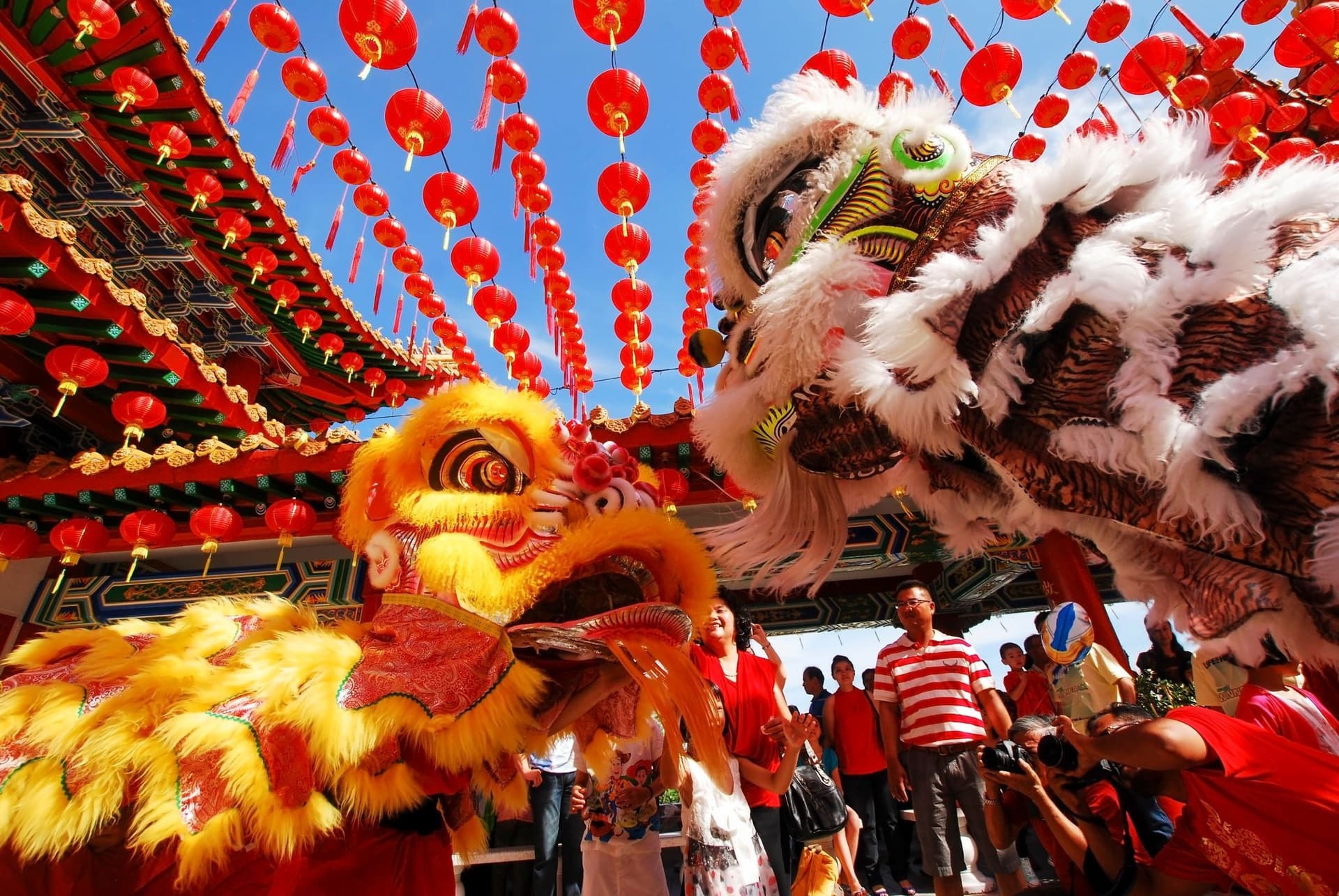
The finale: glowing lantern fairs, riddle games, dragon dances and sweet tangyuan dumplings. In 2027 it falls on a Saturday, so expect spectacular crowds — and spectacular scenes.
Essential Spring Festival Traditions
Inscribed on UNESCO’s Intangible Cultural Heritage list in December 2024, the Spring Festival is China’s most complete living tradition. Core customs include:
Spring couplets (chunlian) — red paper verses pasted on doorways
Red envelopes (hongbao) — cash gifts from elders to children, increasingly digital via WeChat
Firecrackers & fireworks — driving off the beast “Nian”; note that city centers operate designated zones or bans
New Year visits (bainian) — greetings of “Xin Nian Kuai Le” and “Gong Xi Fa Cai”
Temple fairs (miaohui) — folk performances, crafts and street food
The CCTV New Year Gala — watched by an audience of hundreds of millions on New Year’s Eve
Must-Eat Chinese New Year Foods
Every dish carries a wish for the year ahead:
Dumplings (jiaozi) — the northern essential, shaped like ancient gold ingots; families wrap them together on New Year’s Eve
Whole fish (yu) — served for “surplus every year” (nian nian you yu)
Niangao (sticky rice cake) — symbolizing rising prosperity
Tangyuan — sweet glutinous rice balls for reunion, eaten at the Lanter Festival
Spring rolls & longevity noodles — for wealth and long life
Practical Tips for Chinese New Year 2027 Travel
Book early: During chunyun (roughly late January to early March), train tickets go on sale only 15 days before departure and sell out fast; reserve hotels one to two months ahead.
Check the official holiday schedule: The State Council confirms the 2027 public-holiday calendar in late 2026 — monitor it for adjusted working weekends.
Know what’s open: Major sights and restaurants stay open; banks and small shops close for the first 3–5 days.
Weather: Expect -10°C to -25°C in Harbin, cold dry days in Xi’an and Beijing, mild 15–20°C in Hong Kong.
Payments & entry: Alipay and WeChat Pay accept foreign cards; many nationalities currently qualify for visa-free entry or 240-hour visa-free transit — verify the latest policy before booking.
Fireworks safety: Watch displays from designated areas; many city centers restrict personal fireworks.
FAQ
When is Chinese New Year 2027?
Saturday, 6 February 2027 — the 1st day of the 1st lunar month. New Year’s Eve falls on Friday, 5 February, and the public holiday is expected to run around 5–13 February 2027.
What animal is 2027 in the Chinese zodiac?
2027 is the Year of the Goat (Sheep/Ram), specifically the Fire Goat (Ding Wei), running from 6 February 2027 to 25 January 2028.
How long do the celebrations last?
Officially 8 days of public holiday, but traditional celebrations run 15 days — from New Year’s Eve through the Lantern Festival on Saturday, 20 February 2027.
Is Chinese New Year a good time to visit China?
Yes — for festive atmosphere it is unmatched: temple fairs, ice palaces, lanterns and folk performances everywhere. Expect peak crowds and fully booked trains on 6–10 February; the quieter, equally festive option is traveling west to the Silk Road, where celebrations are authentic and crowds thin.
What is the difference between Chinese New Year and Losar 2027?
Chinese New Year 2027 falls on 6 February; Tibetan Losar 2027 falls on 7 February. In Gansu’s Xiahe, both are celebrated back-to-back, crowned by the Labrang Monlam Festival — a rare double-festival window unique in 2027.
Why do Chinese festival dates change every year?
Festivals follow the lunar calendar, so Gregorian dates shift by several weeks year to year. Always check the current year’s calendar before booking.
Plan Your Goat Year Trip with Silk Road Travel
Silk Road Travel designs private, festival-timed journeys across Xi’an, Gansu, Qinghai and Xinjiang — from Beijing-style temple fairs to a Goat Year sunrise over Dunhuang’s snow dunes, or the once-in-a-generation Labrang Monlam in February 2027.
Email: info@silkroadtravel.com
WhatsApp: +86 159 0991 2575